Kuragala Raja Maha Viharaya
 Religious Places


About Kuragala Raja Maha Viharaya
An awe-inspiring ancient rock monastery and pre-historic cave complex in Balangoda, famed for the Asadisi Maha Seya and sheer clifftop vistas.
Perched dramatically upon a sheer monolithic rock escarpment roughly 24 kilometers south of Balangoda along the scenic Kaltota road, Kuragala Raja Maha Viharaya is one of Sri Lanka's most ancient, spectacular, and spiritually evocative rock sanctuaries. Archaeologically renowned as the oldest pre-historic habitation site in the island's intermediate climatic zone, excavations within its natural rock shelters have unearthed human skeletal remains, microlithic stone implements, and seashell artifacts dating back over 8,000 to 16,000 years to the late Pleistocene and Balangoda Man eras. By the 2nd century BCE, the towering crags had transformed into an austere Buddhist forest hermitage, as attested by dozens of pre-Christian Early Brahmi drip-ledge (katarama) inscriptions commemorating cave donations to Arahat monks by ancient royalty and regional chieftains.
Rising between the dramatic peaks of Kuragala and Hituwangala, the site represents the classical ancient architectural tradition of 'Akasa Chaithya' (sky stupas), where sacred beacons were raised on mountain summits to serve both as holy reliquaries and navigational landmarks across the southern plains. In recent years, the sacred site underwent a monumental spiritual revival known as 'Yali Pibidena Kuragala.' Today, pilgrims ascending the wide granite steps are greeted by the magnificent 130-foot-tall Asadisi Shakya Sugatha Maha Seya—the largest stupa in the Sabaragamuwa Province—flanked by a monumental seated Buddha statue, a golden shrine to deity Saman, massive lion sculptures, and expansive meditation halls designed to accommodate thousands of devotees.
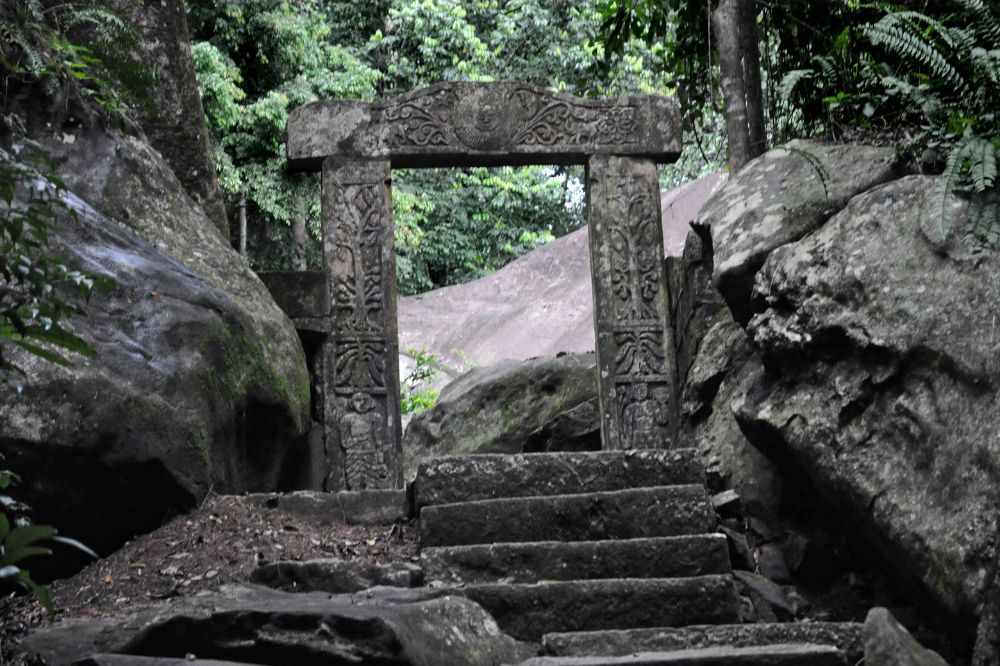
The visitor journey up Kuragala blends deep spiritual reverence with exhilarating cliffside hiking. Well-paved stone stairways weave through shaded boulder groves, past ancient meditation kutis, and up to windswept natural rock galleries that drop vertically over 500 feet into the lush Diyawinna valley below. At the summit platform, standing beside the gleaming stupa, travelers are rewarded with an astonishing 360-degree panorama that encompasses six districts across four provinces, stretching across the undulating ridges of the southern hill country, distant reservoirs, and the untamed borderlands of Udawalawe.
What to expect
Highlights
- Marvel at the 130-foot-tall Asadisi Shakya Sugatha Maha Seya, an imposing sky stupa visible across multiple provinces.
- Explore pre-historic caves containing Early Brahmi drip-ledge inscriptions dating back to the 2nd century BCE.
- Discover the archaeological heritage of the late Pleistocene 'Balangoda Man', with human habitations dating back over 8,000 years.
- Stand at the vertigo-inducing clifftop viewpoints of Hituwangala, gazing down sheer 500-foot precipices into the Kaltota valley.
- Admire the monumental seated Buddha statue and the majestic guardian lion sculptures erected during the temple's revival.
- Enjoy sweeping 360-degree panoramic vistas extending across the Sabaragamuwa hills, Uva mountain ridges, and the southern plains.
Traveler reviews
Ratings and experiences from visitors
No traveler reviews written yet for Kuragala Raja Maha Viharaya.
Traveler photos
Photos of this destination
Questions & answers
What is the dress code or entrance etiquette?
Modest attire covering shoulders and knees is strictly required, with white or light-colored garments strongly encouraged. All footwear and hats must be removed before stepping onto the sacred upper stupa terrace and inner shrine grounds.
What is the entry ticket fee for foreigners and locals?
Admission to Kuragala Raja Maha Viharaya is completely free for both international travelers and Sri Lankan citizens, though voluntary donations placed in temple donation tills to support community services and site maintenance are warmly appreciated.
How physically demanding is the climb to the summit?
The climb involves ascending well-constructed stone and concrete staircases over roughly 20 to 35 minutes. It requires a moderate level of physical fitness, though multiple shaded rest landings and wide pavilions along the path make it manageable for visitors of most ages.
How long does a typical visit take?
A typical visit lasts between 2 to 3 hours, allowing adequate time to make the stair climb, pay homage at the Asadisi Maha Seya, explore the cave hermitages, and absorb the panoramic views.
Are cameras and photography permitted?
Yes, photography and videography are warmly welcomed across the outdoor staircases, stupa terraces, and scenic cliff viewpoints. However, always observe respectful decorum and never pose for photos or selfies with your back turned directly to Buddha statues.