Yapahuwa Rock Fortress
 Ancient Sites

About Yapahuwa Rock Fortress
A dramatic 13th-century medieval rock citadel famed for its monumental carved ornamental staircase and iconic stone lions.
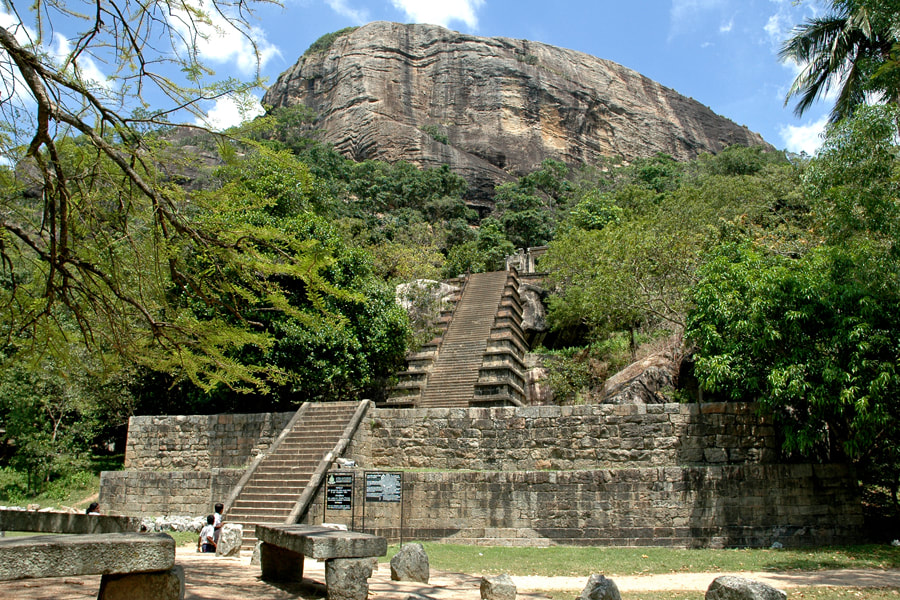
Rising abruptly nearly 100 meters above the surrounding lowland plains midway between Kurunegala and Anuradhapura, Yapahuwa Rock Fortress (originally known as Subhapabbata) served as one of medieval Sri Lanka's most dramatic ephemeral capitals. Originally established as a fortified settlement by the local military leader Subha during the turbulent Polonnaruwa invasion era, the granite monolith was chosen in 1272 CE by King Bhuwanekabahu I to succeed Dambadeniya as the royal seat of the island. Seeking a natural stronghold against South Indian Pandyan invasions, the king brought the Sacred Tooth Relic of the Buddha here and encircled the southern base of the outcrop with concentric double moats, massive earthwork ramparts, and an ornate palace complex.
The crowning architectural masterpiece of Yapahuwa is its ceremonial stone staircase leading up to the former Temple of the Tooth terrace. Built in a striking style showing strong South Indian and Khmer influences, the steep three-tiered stairway is flanked by fiercely expressive Chinese-style 'gajasimha' (mythical lion) sculptures—one of which became immortalized on the old Sri Lankan ten-rupee currency note. The balustrades, Makara Torana archways, and window pediments are intricately chiselled with vibrant bas-reliefs of musicians, whirling dancers, and mythical beasts.
Following King Bhuwanekabahu's death in 1284, Pandyan forces breached the fortress and temporarily seized the Sacred Tooth Relic, leading to Yapahuwa's abandonment as a royal capital and its transformation into a tranquil Buddhist forest monastery. Today, travelers can ascend the steep ceremonial steps, scramble up a rugged trail to the breezy summit plateau dotted with ancient stupa mounds and rock cisterns, and explore the Kandyan-era Yapahuwa Rajamaha Viharaya cave temple and archaeological museum at the base—all with a fraction of the crowds found at Sigiriya.
What to expect
Highlights
- The masterpiece 13th-century Ornamental Staircase featuring steep ceremonial steps and the former Temple of the Tooth porch.
- Iconic stone-carved mythical lions (Singe) guarding the staircase, famously depicted on Sri Lanka's historic 10-rupee banknote.
- Exquisite stone bas-reliefs of dancers, drummers, and perforated stone windows (Sivuru Kavelu) displayed on the stairway and onsite museum.
- Panoramic 360-degree views across the emerald dry-zone plains and distant hills from the 100-meter-high granite summit.
- The Kandyan-era Yapahuwa Rajamaha Viharaya cave temple at the base, containing ancient Brahmi drip-ledge inscriptions and vibrant murals.
- Well-preserved medieval defense earthworks, including concentric double moats, stone ramparts, and royal bathing ponds.
Traveler reviews
Ratings and experiences from visitors
No traveler reviews written yet for Yapahuwa Rock Fortress.
Traveler photos
Photos of this destination
Questions & answers
What is the dress code or entrance etiquette?
Shoulders and knees must be covered for both men and women, as the complex includes an active Buddhist cave temple and former Tooth Relic shrine. Footwear can be worn while climbing the ornamental staircase and hiking to the rock summit, but shoes and hats must be removed when entering the cave temple at the base.
What is the entry ticket fee for foreigners and locals?
Foreign visitors pay approximately LKR 1,500 to 2,000 ($5 to $7 USD) at the archaeological ticket counter, while Sri Lankan citizens pay around LKR 100. The ticket includes access to the rock fortress, the ornamental staircase, the cave temple, and the small onsite archaeological museum.
How long does a typical visit take?
A complete visit takes between 1.5 to 2.5 hours, which allows enough time to explore the outer moats, photograph the ornamental staircase, hike to the rock summit and back, and visit the cave temple and museum.
Are cameras and photography permitted?
Photography is freely permitted throughout the outdoor ruins, ornamental staircase, and rock summit. However, flash photography and posing with your back turned to Buddha statues inside the lower cave shrine are prohibited, and photography inside certain sections of the museum may be restricted.
How difficult is the hike to the top of Yapahuwa Rock?
Reaching the top of the ornamental staircase takes only 10 minutes up very steep stone steps with handrails. Continuing from the staircase terrace to the very top of the rock summit takes an additional 20 to 30 minutes along an uneven, moderately challenging forest and bare-rock trail that requires basic agility and good footwear.