Sorabora Wewa
 Ancient Sites

About Sorabora Wewa
An ancient 2nd-century BC hydraulic marvel near Mahiyangana, renowned for its ingenious rock-hewn sluice gate and tranquil sunrise boat safaris.
Constructed during the reign of King Dutugemunu in the 2nd century BC, Sorabora Wewa (originally known as 'Bintenna Wewa') is one of the most ingenious and enduring achievements of ancient Sri Lankan hydraulic engineering. Spanning over 1,400 acres in the fertile valley of Mahiyangana, the reservoir was built under the legendary labor of the folklore hero Bulatha (Bulatha Yodaya). While working as a laborer hauling stone for the construction of Ruwanwelisaya or Mahiyangana Stupa, Bulatha reputedly used his leisure hours to dam the Diyawanna Oya between two massive natural rock ridges, creating an immense water body to nourish the paddy fields of Bintenna without royal funding.
What sets Sorabora Wewa apart from virtually all other ancient reservoirs across the island is its unique sluice gate (Sorowwa). Instead of the conventional subterranean stone-slab cistern (Bisokotuwa) typical of Anuradhapura-era reservoirs, ancient master artisans hand-carved a massive water canal directly through a 7-meter-wide natural granite outcrop. This prehistoric rock-cut sluice has successfully regulated water outflow for over two millennia without collapsing or silting up, standing today as a masterclass in adapting geology into functional hydraulic technology.
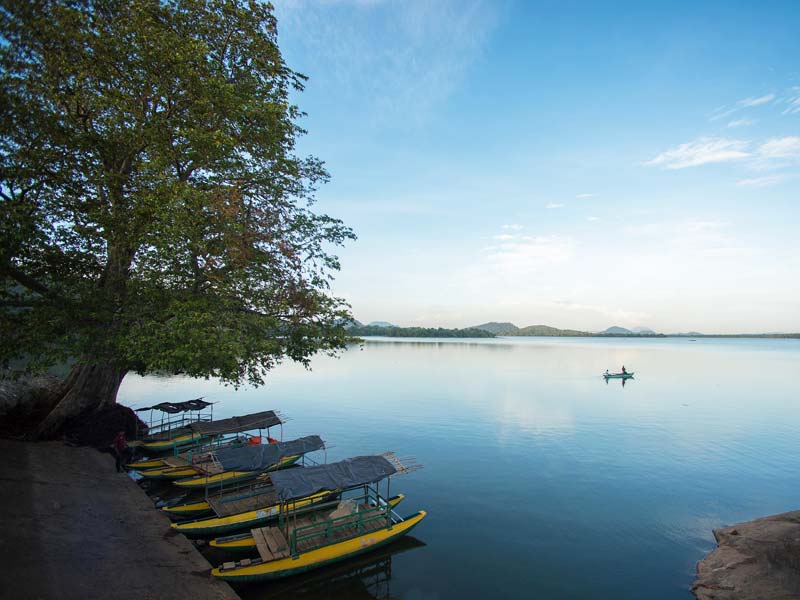
Visiting Sorabora Wewa at first light delivers one of Sri Lanka's most serene wilderness and heritage experiences. As the morning mist gently lifts off the mirror-calm water, the reservoir awakens with vibrant pink lotus blossoms, cormorants drying their wings on half-submerged stumps, and local fishermen casting traditional cast nets from wooden catamarans. Camping along the grassy tree-shaded bund, drifting across the lake on a peaceful early morning boat safari, and watching egrets glide against the backdrop of distant eastern mountain ranges offers an evocative glimpse into the pastoral soul of ancient Ceylon.
What to expect
Highlights
- The 2,200-year-old rock-cut sluice gate (Sorabora Sorowwa) chiseled entirely by hand through a natural granite outcrop
- Scenic wooden catamaran and boat excursions gliding past blooming pink lotuses, water lilies, and bird nesting islets
- Historic folklore heritage tied to the legendary builder Bulatha Yodaya from the era of King Dutugemunu
- Vibrant avifauna watching featuring sea eagles, darter birds, purple herons, kingfishers, and spot-billed pelicans
- A wide, tree-shaded earthen embankment (bund) perfect for peaceful cycling, photography, and twilight picnics
- Authentic local village fisheries where traditional cast-net techniques are practiced against mist-shrouded mountain vistas
Traveler reviews
Ratings and experiences from visitors
No traveler reviews written yet for Sorabora Wewa.
Traveler photos
Photos of this destination
Questions & answers
What is the recommended dress code and visitor etiquette?
Because Sorabora Wewa is a natural and archaeological outdoor site rather than an active temple, casual and comfortable outdoor travel attire is suitable. Lightweight, breathable clothing and sun protection are recommended, along with footwear suitable for walking on earthen banks.
What is the entry ticket fee for foreign and local visitors?
Visiting the lake bund, walking around the banks, and viewing the ancient rock sluice is completely free for all foreign and local visitors. Catamaran or motorized boat safaris operated by local village boatmen typically cost between LKR 1,500 and 3,000 per boat for a 45-minute tour.
How long does a typical visit take?
A standard visit lasts between 1.5 to 2.5 hours, allowing sufficient time to inspect the ancient rock-cut sluice, take a peaceful boat safari across the water, and walk along the shaded embankment.
Are cameras and drone photography permitted?
Yes, personal handheld photography and videography are freely permitted and exceptionally rewarding during sunrise and sunset. Flying recreational drones over the water is generally permitted, but operators must avoid disturbing nesting waterfowl or local fishing boats.
How do you reach Sorabora Wewa from Mahiyangana town?
Sorabora Wewa is located approximately 4 kilometers northeast of Mahiyangana town center. It can be easily reached via a 10-minute tuk-tuk or taxi ride along the Mahiyangana–Girandurukotte Road.