Muthiyangana Raja Maha Vihara
 Religious Places


About Muthiyangana Raja Maha Vihara
An ancient Solosmasthana temple in Badulla enshrining sacred pearl-like sweat relics from Gautama Buddha's historic third visit to Sri Lanka.
Nestled in the lush mountain basin of Badulla along the tranquil Badulu Oya, Muthiyangana Raja Maha Vihara is one of Sri Lanka's sixteen holiest Buddhist sanctuaries, revered as a Solosmasthana. The temple's sacred origins date back to the 5th century BC, when Gautama Buddha made his third and final visit to the island at the invitation of local chieftain King Indika, guardian deity of the nearby Namunukula mountain range. According to ancient chronicles, as the Buddha meditated at this site, drops of his perspiration miraculously crystallized into radiant pearls (mutu), which were enshrined alongside sacred hair relics within the initial stupa erected by King Indika.
Over subsequent centuries, the temple flourished under the patronage of prominent Sinhalese monarchs. King Devanampiya Tissa further sanctified the grounds in the 3rd century BC by planting one of the thirty-two saplings derived from the sacred Jaya Sri Maha Bodhi of Anuradhapura. Later, King Jettha Tissa II and King Dhatusena expanded the chetiya, while monarchs of the Kandyan Kingdom restored the image houses, contributing exquisite polychromatic wall paintings, dragon arches (Makara Thorana), and guardian deities that survive to this day.
Today, the temple stands as a serene spiritual refuge in the heart of Badulla town. The immaculately whitewashed stupa rises 65 feet into the misty highland sky, surrounded by whispering bo leaves, burning clay oil lamps, and the soothing fragrance of purple water lilies and jasmine blossoms. Pilgrims dressed in pristine white circle the sandy terrace while monastic chanting and traditional temple drumming during the daily Thevava services infuse the atmosphere with deep, timeless devotion.
What to expect
Highlights
- The revered 65-foot central stupa enshrining the sacred pearl-like sweat relics (Mukthaka Dhatu) and hair relics of the Buddha
- The sacred Dambadiva Bodhi tree, grown from an authentic sapling of the Anuradhapura Jaya Sri Maha Bodhi
- The ornate Makara Thorana (Dragon Arch) entrance gate featuring mythical guardian sculptures and celestial figures
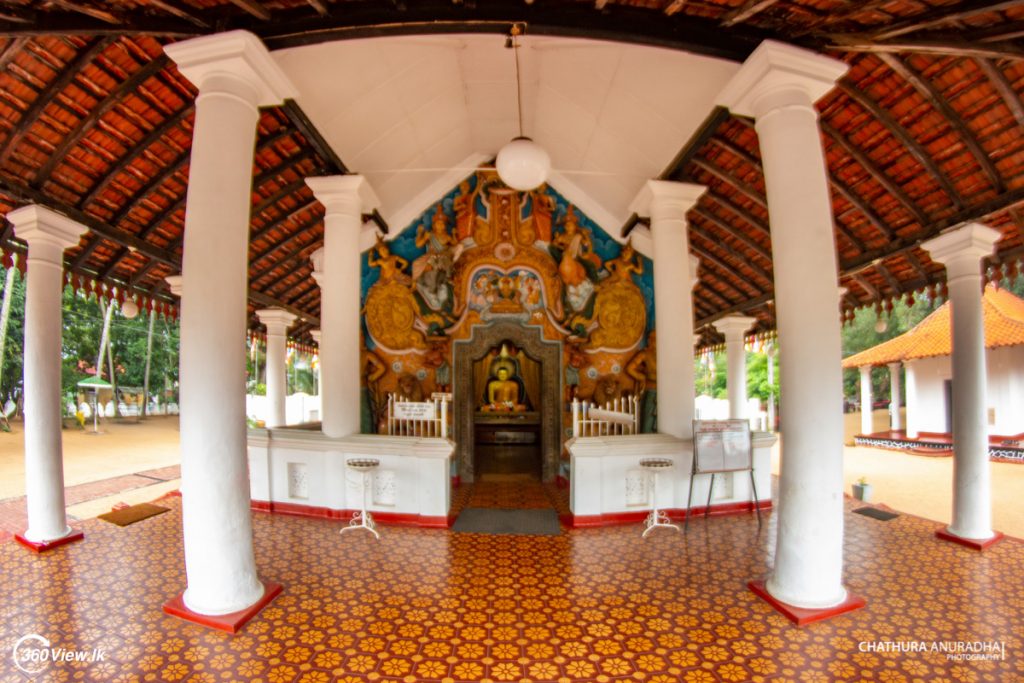
- Medage Viharaya and Viharageya image houses adorned with Kandyan-era Buddhist murals and reclining Buddha statues
- The historic shrine dedicated to King Indika, the local guardian deity of Badulla and the Namunukula range
- The peaceful sand-strewn courtyard lined with clay oil lamp stands and historic stone moonstones
Traveler reviews
Ratings and experiences from visitors
No traveler reviews written yet for Muthiyangana Raja Maha Vihara.
Traveler photos
Photos of this destination
Questions & answers
What is the dress code or entrance etiquette?
Visitors must dress modestly with shoulders, chest, and knees completely covered. White or light-colored attire is customary and respected. Footwear and hats must be removed and checked into the shoe counter at the gate before crossing into the inner sanctum.
What is the entry ticket fee for foreigners and locals?
Admission to Muthiyangana Raja Maha Vihara is completely free for both foreign visitors and Sri Lankan citizens. Visitors may make voluntary cash donations into the official temple collection boxes or purchase oil lamps and flowers.
How long does a typical visit take?
A typical visit takes between 45 and 75 minutes, which provides ample time to pay respects at the main stupa, visit the two image houses, circumambulate the sacred Bodhi tree, and soak in the peaceful courtyard atmosphere.
Are cameras and photography permitted inside the temple?
Outdoor photography of the stupa, Bodhi tree, and architecture is permitted. However, avoid using flash inside the shrine rooms to protect historic murals, and never turn your back toward any Buddha statue while taking photos or selfies.
How do you reach the temple from Badulla Railway Station?
The temple is located less than 1.5 kilometers from Badulla Railway Station and can be reached via a quick 5-minute tuk-tuk ride or a pleasant 15-minute walk through the center of Badulla town.