Fort Frederick
 Historical

About Fort Frederick
A 17th-century coastal fortress in Trincomalee where grazing wild spotted deer, colonial ramparts, and sacred oceanfront temples intertwine.
Constructed in 1624 by Portuguese commander Constantino de Sá de Noronha on the narrow neck of the strategic Trincomalee promontory, Fort Frederick stands as one of the most storied military citadels in Sri Lanka. Originally known as the Fort of Triquillimale, the stronghold was built upon the ruins of the revered ancient Koneswaram Temple, with Portuguese engineers utilizing carved granite pillars and masonry razed from the historic sanctuary. The outpost surrendered to the Dutch East India Company (VOC) under Admiral Westerwolt in 1639, following which the Dutch dismantled and rebuilt the fortifications in 1665 into a reinforced pentagonal fortress. It later fell to British imperial forces under General Hector Munro in 1782 and finally in 1795, renamed in honor of King George III's son, Prince Frederick, Duke of York.
Today, Fort Frederick presents a fascinating and harmonious convergence of colonial military defense, active garrison life, and living wildlife. Maintained by the Sri Lanka Army as an operational cantonment, the fortress grounds remain freely accessible to the public, pilgrims, and international travelers. The wide, paved roadway winding through the compound is sheltered by an ancient canopy of sprawling banyan, tamarind, and neem trees. Most enchanting of all is the fort's resident herd of docile wild spotted deer (chital), which wander nonchalantly across manicured lawns, graze along roadside verges, and rest beside colonial barracks, completely unbothered by passing vehicular or pedestrian traffic.
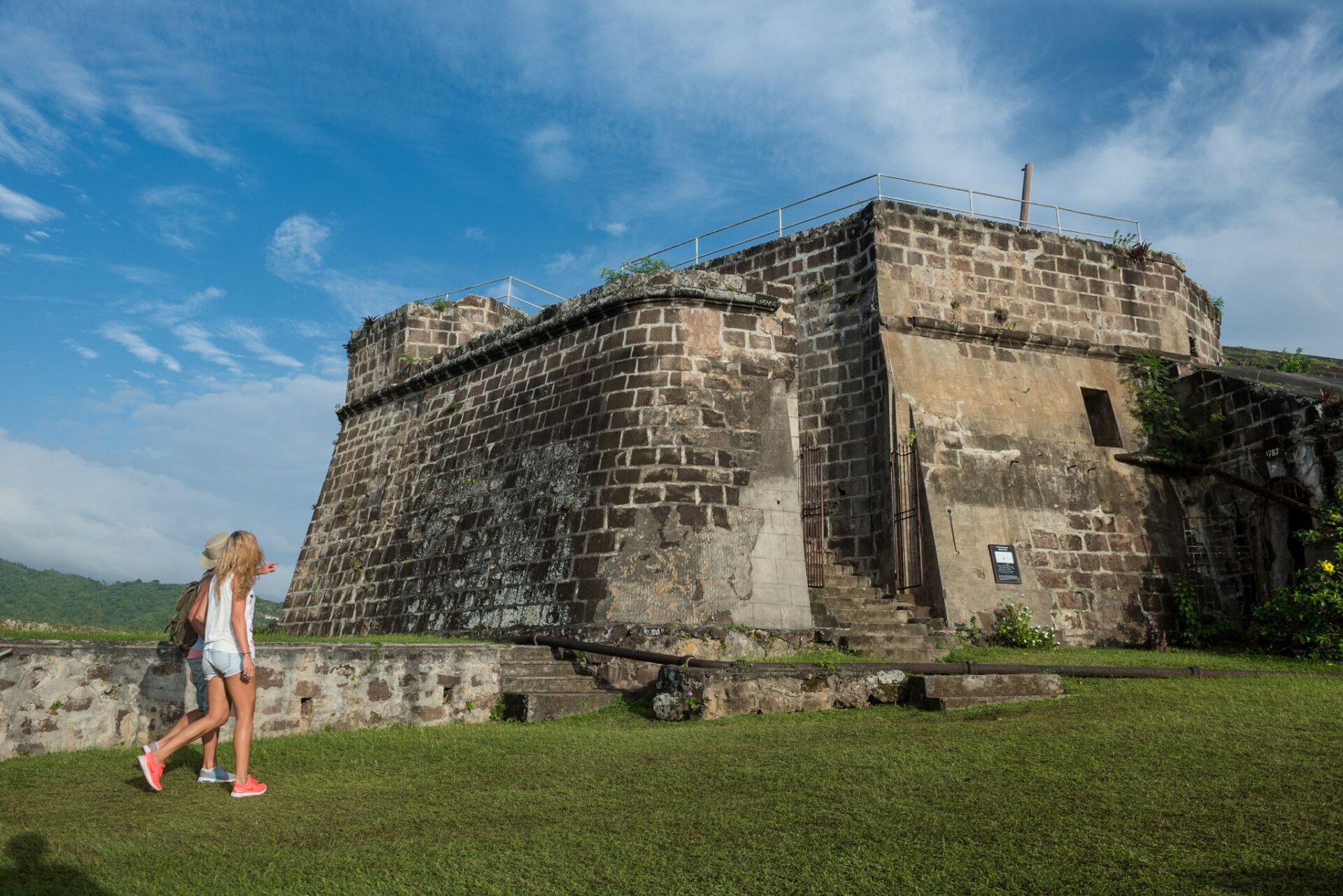
Wandering through the fort reveals a rich tapestry of coastal history and panoramic sceneries. Visitors can inspect weathered stone bastions, massive sally ports, Dutch coat of arms engravings, antique iron artillery cannons, and British-era administrative buildings such as the historic Wellesley House. The main avenue ascends gently along the peninsula towards the Gokanna Buddhist Vihara and the breathtaking clifftops of Swami Rock, where Koneswaram Kovil commands sweeping vistas over the world's deepest natural harbor, making Fort Frederick an unforgettable historical and ecological gateway on Sri Lanka's eastern seaboard.
What to expect
Highlights
- Pass beneath the imposing 17th-century stone entrance gate bearing the historic Dutch East India Company (VOC) crest.
- Encounter dozens of docile wild spotted deer roaming freely across shaded lawns and beneath spreading banyan trees.
- Walk along preserved coral-and-granite ramparts and bastions overlooking the turquoise expanse of Dutch Bay and Back Bay.
- Discover colonial-era military artifacts, including antique British cannons, garrison barracks, and the historic Wellesley House.
- Follow the picturesque, tree-lined avenue ascending toward Gokanna Buddhist Vihara and the dramatic cliffs of Swami Rock.
Traveler reviews
Ratings and experiences from visitors
No traveler reviews written yet for Fort Frederick.
Traveler photos
Photos of this destination
Questions & answers
What is the dress code or entrance etiquette?
Modest casual attire covering shoulders and knees is recommended. While fort grounds are casual, the main road leads directly to Koneswaram Temple and Gokanna Vihara, where modest attire is strictly required and shoes must be removed before entering temple terraces.
What is the entry ticket fee for foreigners and locals?
Access to Fort Frederick, its ramparts, and the public thoroughfare is 100% free of charge for both international travelers and Sri Lankan citizens.
How long does a typical visit take?
A typical visit takes between 1.5 to 2.5 hours, providing plenty of time to stroll past the colonial barracks, photograph the spotted deer, walk the ramparts, and continue upward to Swami Rock.
Are cameras and photography permitted?
Photography of the spotted deer, natural sceneries, ramparts, and historic colonial facades is warmly permitted. However, because it is an active military base, photographing active army checkposts, guard rooms, and armed sentries is strictly forbidden.
Can vehicles drive inside Fort Frederick?
Yes, private cars, vans, and tuk-tuks are permitted to drive along the main paved road inside the fort up to the visitor drop-off point near Koneswaram Kovil, though walking is the best way to soak in the tranquil atmosphere.


