Keerimalai Sacred Water Spring

About Keerimalai Sacred Water Spring
A sacred seaside mineral spring in Jaffna, famed for its therapeutic healing waters, ancient folklore, and stone-walled oceanfront bathing pools.
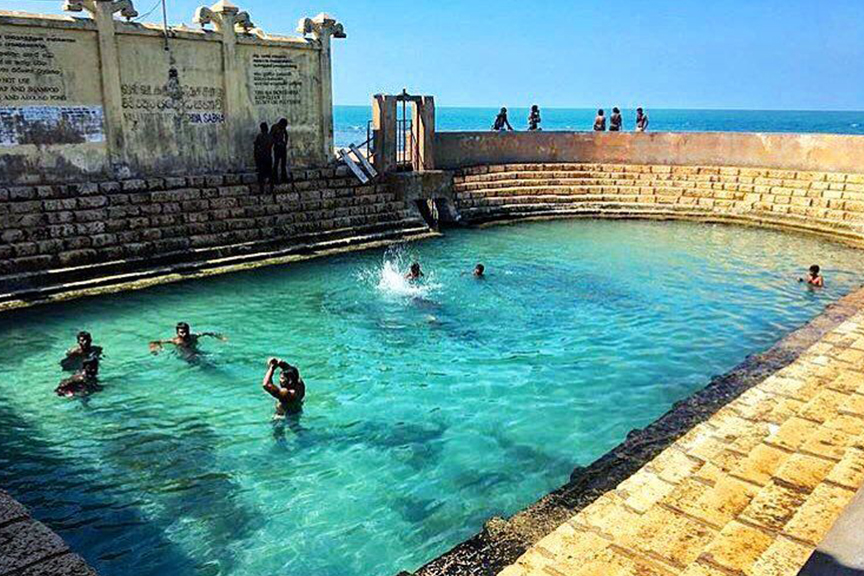
Perched dramatically on the northernmost rim of the Jaffna Peninsula overlooking the turquoise waters of the Palk Strait, the Keerimalai Sacred Water Spring (Keerimalai Theertham) is one of Sri Lanka's most extraordinary natural and spiritual sanctuaries. Despite being located mere meters from the crashing saltwater waves of the ocean, the spring continually discharges pure, crystal-clear freshwater sourced from subterranean karst limestone aquifers. Enclosed within stone-cut bathing tanks directly bordering the open sea, this natural mineral spring has been venerated for centuries for its buoyant, curative, and purifying qualities.
The site's sacred lore is deeply woven into northern Hindu heritage. The name 'Keerimalai' translates to 'Mongoose Hill' in Tamil, deriving from ancient folklore concerning Sage Nagula Muni, an ascetic sage born with a face resembling a mongoose, whose affliction was miraculously cured after bathing in the mineral-rich waters. Further legends recount how the 8th-century Chola princess Maruthapura Veeravalli bathed in the spring to cure a facial deformity, subsequently commissioning the adjoining Keerimalai Naguleswaram Kovil—one of Sri Lanka's five revered Pancha Ishwarams dedicated to Lord Shiva.
Today, the spring remains a vibrant pilgrimage destination, especially during the auspicious Aadi Amavasya festival when tens of thousands of devotees gather to offer ancestral prayers and take ritual cleansing dips. The complex features separate stone-walled bathing enclosures for men and women, where visitors can descend wide steps into cool, mineral-rich waters while gazing across the low sea wall at the ocean horizon. Blending sacred mythology, geologic intrigue, and tranquil coastal vistas, Keerimalai offers an unforgettable cultural and wellness experience in northern Sri Lanka.
What to expect
Highlights
- Bathe in crystal-clear, mineral-rich freshwater bubbling up naturally just footsteps from the salty waves of the Palk Strait.
- Experience the historic stone-cut coastal bathing tanks with open views across the turquoise northern ocean horizon.
- Learn about millennia of sacred Hindu lore surrounding Sage Nagula Muni and the miraculous healing of Princess Maruthapura Veeravalli.
- Visit the adjacent Keerimalai Naguleswaram Kovil, one of Sri Lanka's five ancient and holiest Shiva temples (Pancha Ishwarams).
- Witness sacred Hindu purification rituals and ancestral remembrance ceremonies during the auspicious Aadi Amavasya festival.
- Stroll along the breezy coastal seawall to watch local fishing catamarans navigate the sparkling northern waters.
Traveler reviews
Ratings and experiences from visitors
No traveler reviews written yet for Keerimalai Sacred Water Spring.
Traveler photos
Photos of this destination
Questions & answers
What is the dress code or entrance etiquette?
Modest clothing is strictly required. Bathers must wear t-shirts and swim shorts or traditional sarongs/lungis; revealing western swimwear is culturally inappropriate. Facilities are strictly segregated into separate pools for men and women.
What is the entry ticket fee for foreigners and locals?
Access to Keerimalai Sacred Water Spring is completely free for both international visitors and locals, though a small nominal fee or voluntary donation of 20 to 50 LKR may be collected for vehicle parking and facility maintenance.
How long does a typical visit take?
A typical visit lasts between 1 to 2 hours, allowing sufficient time for a relaxing swim or ritual dip, changing, and visiting the adjacent Naguleswaram Kovil.
Are cameras and photography permitted?
Photography is permitted around the exterior grounds, ocean seawall, and scenic surroundings. However, photography and videography are strictly prohibited inside the bathing tanks while people are swimming, in order to respect bather privacy.
How does fresh water emerge right beside the ocean?
The water originates from deep underground limestone karst cave networks that naturally collect and filter rainwater across the Jaffna Peninsula, venting upward as a pressurized freshwater spring right at sea level.

